

IPTV vs Cable TV: Which One Should You Choose in Canada?
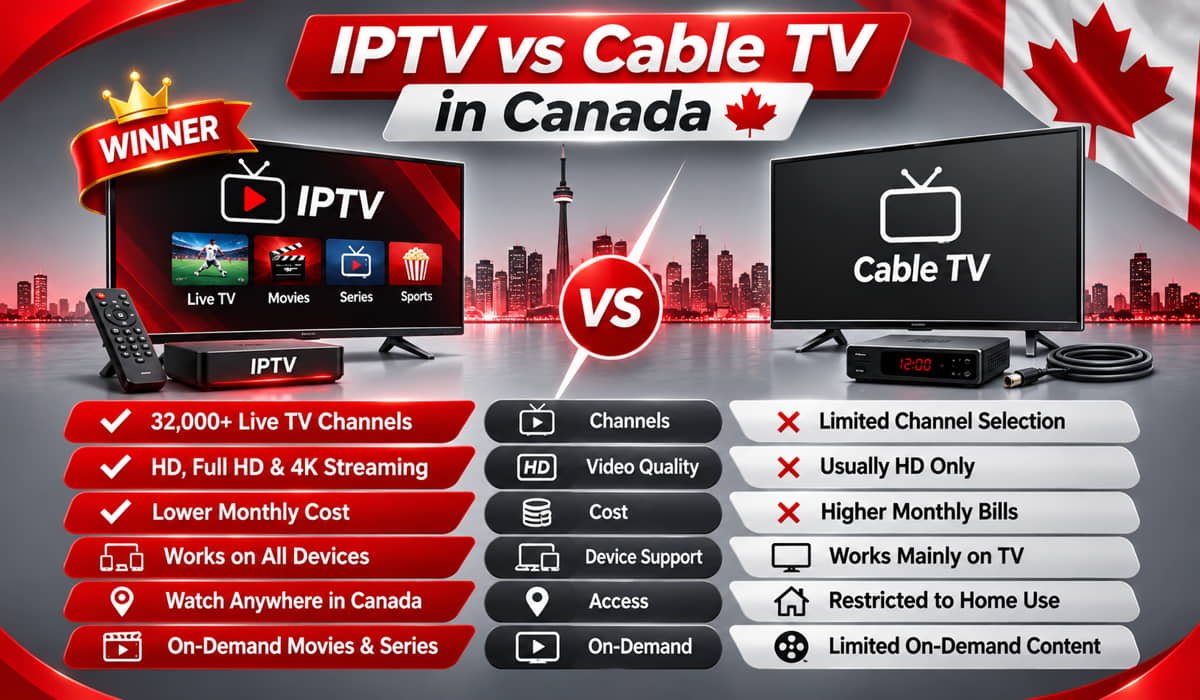
Choosing between IPTV and traditional cable TV in Canada depends on how you watch television, which channels you need, and how reliable your internet connection is. Both deliver live programming and entertainment, but they use different delivery systems. IPTV offers internet-based access across compatible devices, while cable TV uses traditional cable infrastructure.
For households that value flexible viewing, multiple devices, and modern entertainment options, IPTV is often the more adaptable choice.
IPTV vs Cable TV: Which Is Better in Canada?
IPTV is the better overall choice for many Canadian households that want flexible viewing, compatible-device access, and internet-based television. It allows viewers to access television programming through supported Smart TVs, streaming devices, smartphones and computers, depending on the service and application.
Traditional cable TV can still suit households that prefer a conventional television package and do not want their TV reception to depend on their home broadband connection.
The main difference is how the content reaches your screen. IPTV uses Internet Protocol networks, whereas traditional cable TV distributes programming through cable infrastructure. IPTV can offer greater flexibility in device access and subscription choices, but its performance depends on internet quality and the provider’s service.
For viewers with reliable broadband who want more control over how and where they watch television, IPTV is a strong alternative to conventional cable.
IPTV vs Cable TV Comparison at a Glance
| Comparison factor | IPTV | Traditional cable TV |
|---|---|---|
| Delivery method | Internet Protocol network | Cable television infrastructure |
| Internet requirement | Requires an internet connection | Usually does not require home broadband for TV delivery |
| Viewing devices | Compatible Smart TVs, streaming devices, phones and computers | Primarily televisions and compatible cable equipment |
| Content access | Live TV and potentially on-demand content | Live TV and potentially on-demand content |
| Subscription structure | Provider-dependent subscription packages | Provider-dependent channel packages |
| Installation | Application or compatible device setup | Usually cable connection and provider equipment |
| Portability | May support viewing across compatible locations and devices, subject to provider terms | Generally tied to the installed cable service |
| Picture quality | Depends on stream quality, bandwidth and device | Depends on package, signal and equipment |
| Internet dependency | Yes | Generally no for traditional cable delivery |
| Flexibility | Often more flexible in device and access options | Often more closely tied to conventional television equipment |
The table shows the general differences between the two technologies. Actual features depend on the service provider, subscription package, device and network conditions. Not every IPTV subscription provider in Canada includes the same channels or on-demand library, and cable providers also offer different packages and features.
What Is IPTV?
IPTV stands for Internet Protocol Television. It is a method of delivering television programming through internet-based networks instead of relying on traditional cable television infrastructure.
With IPTV, television content is delivered through an IP network to a compatible device. Viewers can access available programming through an IPTV application or supported platform.
Depending on the service, IPTV may provide:
- Live television channels.
- Movies and television series.
- Video-on-demand libraries.
- International and regional programming.
- Electronic programme guides.
- Different content categories.
One of IPTV’s main advantages is its flexibility. A compatible service may allow viewers to watch television on a Smart TV, Fire TV Stick, Android TV box, smartphone, tablet or computer.
However, IPTV is a delivery technology, not a guarantee of specific channels, content rights or streaming quality. Those features depend on the provider and its service arrangements.
How Does IPTV Work?
IPTV uses internet-based infrastructure to deliver video streams to a viewer’s device.
The general process works as follows:
- Content delivery: An IPTV service makes television content available through its delivery infrastructure.
- Internet connection: The viewer connects a compatible device to the internet.
- Application access: An IPTV application or supported player connects to the service.
- Stream delivery: The application receives the requested video stream through the IP network.
- Playback: The device processes the stream and displays the television content.
Several components work together during this process:
- IP networks: Carry data between the service and viewer.
- Streaming servers: Make video streams available to connected devices.
- IPTV applications: Provide the interface used to access available content.
- Internet bandwidth: Determines how much data can be transferred over a connection.
- Compatible devices: Decode and display the received video.
IPTV performance depends on more than the internet speed advertised by an ISP. Network stability, latency, congestion, device capability and stream quality can all affect playback.
What Is Cable TV?
Cable television is a traditional television delivery system that distributes programming through a cable provider’s infrastructure.
A cable company supplies television signals through its network to subscribers’ homes. The signal is received through a cable connection and processed by a television or compatible receiver.
Unlike IPTV, traditional cable TV generally does not depend on the household’s broadband connection to deliver television programming.
Cable television remains familiar to many Canadian households. Viewers typically select channels through a television guide, remote control or provider-supplied equipment.
Depending on the package, cable services may include:
- Live television channels.
- News and entertainment programming.
- Sports channels.
- Movie channels.
- Regional programming.
- On-demand features.
The available content depends on the provider and subscription package.
How Does Cable Television Work?
Traditional cable television distributes programming through a cable network.
The process generally involves four steps:
- Content distribution: Television programming enters the cable provider’s distribution network.
- Signal transmission: The provider distributes television signals through its cable infrastructure.
- Home connection: The signal reaches the subscriber’s property through a cable connection.
- Television reception: A television or compatible receiver decodes the signal so viewers can select channels.
Traditional cable systems may use coaxial cable and provider-supplied receivers or set-top boxes.
The viewer normally uses a remote control and electronic programme guide to navigate the available channels. The television service generally operates independently of the home’s broadband connection, although some additional provider features may use internet connectivity.
IPTV vs Cable TV: 10 Major Differences
Both technologies provide television entertainment, but their delivery methods create differences in cost structure, device compatibility, installation and viewing flexibility.
1. Cost and Subscription Pricing
Cost is an important consideration when choosing a television service in Canada. However, comparing IPTV and cable TV requires more than looking at the advertised monthly subscription price.
Traditional cable packages may include different channel groups, equipment charges, installation costs, optional add-ons and promotional rates. Some subscriptions also have contract periods or cancellation conditions.
IPTV providers structure their subscriptions differently. Some offer flexible packages and may not require the same cable installation or receiver arrangement as traditional cable. Viewers can use compatible devices and applications when the service supports them.
Before choosing either option, compare the complete cost.
| Cost factor | IPTV | Cable TV |
|---|---|---|
| Monthly subscription | Depends on provider and package | Depends on provider and channel package |
| Equipment | May use existing compatible devices | May require provider equipment |
| Installation | Often application-based setup | May involve cable installation |
| Additional channels | Depends on subscription | May require package upgrades |
| Contract terms | Provider-dependent | Provider-dependent |
| Internet cost | Broadband is required | Broadband may be separate |
One important point is that IPTV requires an internet connection. If you do not already have broadband, include its monthly cost when comparing the total household expense.
Which is better? IPTV may offer more flexible subscription arrangements for some households, but it is not automatically cheaper. Compare the total monthly cost, equipment requirements, taxes and contract terms before making a decision.
2. Channel Selection and Content Variety
Channel selection is another major factor, particularly for households with different entertainment preferences.
Traditional cable TV generally organizes programming into provider-defined channel packages. These may include local channels, news, entertainment, sports and movie channels.
IPTV services can organize available content into different categories through an application. Depending on the provider, these categories may include:
- Live television.
- News and current affairs.
- Movies and series.
- Sports programming.
- International television.
- Regional-language entertainment.
- On-demand content.
Internet-based delivery gives IPTV providers flexibility in how they organize and distribute content. This can be useful for viewers looking for programming from different countries or language categories.
However, more channels do not automatically mean a better service. The actual selection, availability and authorization of content depend on the provider and subscription.
Which is better? IPTV can be attractive to viewers seeking a broad range of content categories, especially international programming. Cable TV may be sufficient for people who only need a familiar selection of local and national channels.
3. Device Compatibility
Device compatibility is one of IPTV’s strongest advantages.
Traditional cable television is primarily designed around a television connected to the provider’s equipment. Some cable companies offer additional viewing options, but access generally depends on their supported equipment and services.
IPTV can work across different device categories when the service and application support them.
| Device | IPTV | Traditional cable TV |
|---|---|---|
| Smart TV | Supported by compatible applications | Supported through cable connection or receiver |
| Amazon Fire TV Stick | Supported by compatible applications | Usually requires a separate supported viewing solution |
| Android TV box | Supported by compatible applications | Depends on provider-supported options |
| Android smartphone | Supported by compatible applications | Depends on provider-supported mobile options |
| iPhone and iPad | Supported by compatible applications | Depends on provider-supported mobile options |
| Windows computer | Supported by compatible players | Depends on provider-supported web or app access |
| Mac computer | Supported by compatible players | Depends on provider-supported web or app access |
This flexibility means an IPTV subscriber may be able to use a compatible device already available at home rather than relying entirely on a conventional cable receiver.
For example, one household member may prefer watching on a Smart TV, while another uses a tablet or phone. Whether they can stream simultaneously depends on the subscription’s connection limits.
Which is better? IPTV offers greater device flexibility when the selected service supports multiple platforms. Cable TV remains convenient for households that prefer a traditional television and receiver setup.
4. Installation and Setup
Installation is another area where the technologies differ.
Traditional cable TV may require a provider connection to the property, compatible equipment and activation. Depending on the home and provider, installation may involve a technician.
IPTV can be simpler to configure in homes that already have a suitable internet connection and compatible hardware.
A typical IPTV setup requires:
- A working internet connection.
- A compatible television or streaming device.
- An IPTV application supported by the service.
- A legitimate subscription.
- Correct login or configuration details.
Once the application is installed, users can enter the required login information or import a playlist, depending on the service.
This does not mean every IPTV service requires no installation. Some setups may involve device configuration, application activation or additional instructions.
Cable TV generally involves a more conventional installation process because the television signal is delivered through the provider’s cable infrastructure.
Which is better? IPTV can be easier to set up when the household already has compatible equipment and reliable internet. Cable TV may be more convenient for people who prefer provider-installed equipment and a conventional television experience.
5. Portability and Viewing Flexibility
Traditional cable television is generally associated with the location where the provider’s cable connection is installed.
IPTV can offer more flexibility because it uses internet connectivity and compatible applications. Depending on the provider’s terms, a subscriber may be able to access the service from different supported devices or locations.
For example, someone might use IPTV on a Smart TV at home and a compatible phone while travelling. However, access outside the home is not guaranteed by the technology itself.
The service may impose restrictions involving:
- Registered devices.
- Simultaneous connections.
- Geographic availability.
- Account authorization.
- Supported applications.
Cable television is generally less portable because it depends on the installed cable service and compatible equipment.
Which is better? IPTV is often the more flexible option for people who want to watch on different compatible devices. Check the provider’s access and connection rules before assuming you can use the subscription anywhere.
6. Picture Quality
Picture quality matters when watching live sports, films, series and other high-resolution programming.
IPTV can deliver SD, HD, Full HD and 4K content when the service, stream and playback equipment support those formats.
However, the viewing experience depends on several technical factors:
- Video bitrate.
- Stream resolution.
- Compression.
- Internet bandwidth.
- Network stability.
- Device processing capability.
- Screen resolution.
A fast internet connection alone does not guarantee high-quality video. The provider must also supply a suitable stream, and the playback device must support its resolution.
Cable TV quality also varies according to the provider, package, signal and equipment. A well-maintained cable connection can provide a stable viewing experience without depending on household broadband.
For IPTV, network congestion or unstable Wi-Fi can cause buffering, reduced quality or interruptions. Using a reliable connection and compatible device can help improve playback.
Which is better? Neither technology automatically wins on picture quality. IPTV can provide excellent high-resolution playback when the stream and network support it, while cable can also deliver consistent quality through its own infrastructure.
7. Internet Dependency
Internet dependency is the biggest technical difference between IPTV and traditional cable television.
IPTV relies on an internet connection to receive television streams. The quality of that connection can affect playback.
Important factors include:
- Download bandwidth.
- Network stability.
- Latency.
- Network congestion.
- Wi-Fi signal strength.
- Number of devices using the connection.
Users can generally connect compatible IPTV devices through Wi-Fi or Ethernet, depending on the equipment and application.
Traditional cable television receives programming through cable infrastructure. Its normal television delivery generally operates independently of the home’s broadband connection.
This can make cable a convenient option for households with unstable or limited internet service.
Which is better? Cable has an advantage when broadband reliability is poor. IPTV is a stronger choice for households with stable internet that want the flexibility of internet-based television.
8. Content Updates and On-Demand Viewing
Modern viewers often want more than scheduled television channels. They may also want movies, series and programmes they can access when convenient.
Both IPTV and cable providers may offer on-demand entertainment, but the available features depend on the service.
IPTV services can combine live television and video-on-demand within a compatible application. Depending on the subscription, users may find:
- Live TV channels.
- Movies.
- Television series.
- Catch-up TV, where offered.
- Electronic programme guides.
- Different content categories.
This can create a convenient viewing experience because users may access different types of entertainment through one interface.
Cable providers may also offer on-demand libraries and programme guides. Their features vary according to the provider and package.
Which is better? IPTV can be attractive to viewers who want live television and on-demand entertainment organized in one application. However, compare the actual catalogue and features rather than assuming every service offers the same content.
9. International and Regional Entertainment
Canada has multicultural households with different language and entertainment preferences. Some viewers want Canadian programming, while others also enjoy content from India, Pakistan, the United Kingdom and other countries.
Traditional cable packages may include international or multilingual channel options, depending on the provider and available packages.
IPTV can also be attractive for international entertainment because internet-based services can organize programming into different country, language and category groups.
Viewers may look for:
- Punjabi television.
- Hindi entertainment.
- Tamil programming.
- Telugu channels.
- International news.
- South Asian movies and series.
- Cultural and regional entertainment.
The actual availability depends on the service’s content catalogue and distribution rights. Not every IPTV subscription includes every language or international channel.
Which is better? IPTV can offer an appealing alternative for multicultural households seeking varied international and regional programming. The best choice depends on whether the selected service actually provides the content they want.
10. Flexibility and Future Viewing
Television habits have changed as internet-connected devices have become part of everyday entertainment.
Many viewers now use Smart TVs, streaming devices, smartphones and computers to watch different types of content. App-based services also allow users to access entertainment through interfaces that are different from traditional channel packages.
IPTV fits naturally into this internet-connected viewing environment.
Its main flexibility advantages include:
- Application-based access.
- Compatible-device viewing.
- Internet-based content delivery.
- Potential access to live and on-demand programming.
- Different subscription structures across providers.
Traditional cable television remains useful for viewers who prefer its conventional setup. There is no reason to assume it will disappear completely.
However, households that want more flexibility in how they access television may find IPTV better suited to their viewing habits.
Which is better? IPTV is more aligned with multi-device and internet-connected viewing habits, making it an adaptable option for many modern households.
Why Choose IPTV Over Traditional Cable TV?
After comparing the two technologies, IPTV stands out for households that want flexible access, compatible-device viewing and internet-based entertainment.
Its advantages become clearer when you consider how people use television today.
More Flexible Viewing Across Compatible Devices
IPTV can support different devices through compatible applications. Instead of relying primarily on a traditional cable receiver, viewers may be able to use a Smart TV, Fire TV Stick, Android TV box, smartphone or computer.
This is useful for households where people have different viewing preferences.
A family member might watch a programme on the living-room television, while another prefers a compatible tablet. The actual number of simultaneous streams depends on the provider’s subscription rules.
Internet-Based Television Access
IPTV uses an internet connection to deliver programming. This means viewers do not necessarily need a conventional cable television connection to access the service.
For households that already have reliable broadband, IPTV can be a convenient way to add internet-based television.
It also fits naturally into homes where Smart TVs and streaming devices are already part of the entertainment setup.
Flexible Subscription Options
IPTV providers can structure their subscriptions differently, offering various durations, packages and content selections.
This can give viewers more choice when comparing available services.
However, not all subscriptions have the same terms. Some may differ in supported devices, content availability, renewal conditions and simultaneous connections.
Compare the complete package rather than choosing only by its advertised price.
Live TV and On-Demand Entertainment Together
IPTV services can combine live channels and on-demand content through a compatible application.
Depending on the subscription, viewers may be able to switch between live programming, movies and series without using separate television delivery equipment.
This can be convenient for households that enjoy both scheduled television and entertainment they can watch at their preferred time.
More Options for International and Regional Content
Canadian households may have different language preferences. Some viewers enjoy Canadian and US programming, while others want South Asian or international entertainment.
IPTV can be appealing when a provider offers relevant regional and international categories.
For example, a household may look for Punjabi, Hindi, Tamil or Telugu programming alongside other entertainment. The availability of these channels depends on the provider’s actual catalogue and content rights.
Convenient Setup with Compatible Devices
If you already have a suitable internet connection and compatible hardware, setting up IPTV can be straightforward.
The usual requirements are an application, supported login details and a subscription. Some applications may require separate activation.
You may not need a traditional cable receiver or a new cable television connection, although setup requirements differ between services.
For viewers with reliable broadband who want flexibility across devices, content categories and subscription choices, IPTV offers a more adaptable television experience than traditional cable TV.
When Is Cable TV Still a Good Choice?
IPTV offers several advantages, but traditional cable television still serves a purpose. It can be the better option for households whose internet connection, viewing habits or existing television arrangements make cable more convenient.
Homes with Unreliable Internet
IPTV depends on internet connectivity. If your broadband service frequently disconnects, has poor performance or is unavailable, IPTV may not provide a dependable viewing experience.
Traditional cable TV generally receives programming independently of home broadband.
For households in areas with limited internet infrastructure, cable may therefore be a more practical choice.
Viewers Who Prefer Traditional Television
Some people prefer the familiar cable television experience.
They may want:
- A conventional remote control.
- A provider-supplied receiver.
- A familiar channel guide.
- Traditional channel packages.
- A television setup that requires little application configuration.
Cable TV can suit viewers who do not want to manage IPTV applications or different login methods.
Households with Existing Cable Bundles
Some Canadian households already have television, internet and phone services bundled through a provider.
If the existing package offers suitable channels, convenient equipment and competitive overall pricing, keeping the arrangement may make sense.
Before switching, compare the total cost of the current bundle with the cost of broadband and a separate IPTV subscription.
Viewers Who Do Not Want to Manage Apps or Devices
IPTV setup may involve installing an application, entering credentials and checking device compatibility.
For people who prefer a provider-installed television receiver and a familiar channel guide, traditional cable may feel easier.
Cable can therefore remain a suitable option for viewers who value simplicity over multi-device flexibility.
Cable television still serves a purpose, but for households prioritizing internet-based access, multi-device flexibility and a wider range of subscription options, IPTV is often the more attractive choice.
IPTV or Cable TV: Which Is Better for Your Household?
The best television option depends on the household’s viewing habits, internet connection, preferred content and budget.
For Families
Families often have different entertainment preferences. Children may watch programmes and cartoons, adults may prefer news or films, and other household members may follow sports or international channels.
IPTV can be convenient when a service supports multiple compatible devices and offers the content categories the family needs.
Before subscribing, check the permitted simultaneous connections. Having access on several devices does not necessarily mean every device can stream at the same time.
Cable TV may suit families who prefer a conventional television package with a familiar receiver and remote control.
Better choice: IPTV is worth considering when the household has reliable internet and wants flexible viewing across supported devices.
For Students and Young Adults
Students and young adults may prefer watching television on laptops, phones, tablets and streaming devices rather than using only a traditional television.
IPTV can suit this viewing style because compatible applications may support different platforms.
It can also be convenient for people who move between accommodation or use different devices, subject to provider terms and geographic restrictions.
Budget matters too. Compare the IPTV subscription, broadband cost and any application fees with available cable packages.
Better choice: IPTV often suits students and young adults who value device flexibility and already have suitable internet access.
For Multicultural and International Households
Many Canadian households enjoy entertainment from different countries and languages.
A household may want Canadian news, Punjabi programmes, Hindi films, Tamil channels or international sports.
IPTV can be an attractive option when its catalogue includes these preferences. Internet-based delivery gives providers flexibility in organizing regional and international content.
However, check the actual channel list and content authorization before subscribing.
Better choice: IPTV may be preferable when the selected service offers the international and regional programming the household wants.
For Sports Fans
Sports viewers need to consider more than the number of channels advertised by a television provider.
Important factors include:
- Availability of the required sports competitions.
- Live event coverage.
- Stream quality.
- Connection stability.
- Supported devices.
- Legitimate broadcasting rights.
IPTV can provide live sports through compatible services, but availability depends on the provider’s authorized content catalogue.
Cable TV may appeal to viewers who prefer established sports packages and conventional television delivery.
Better choice: Compare the actual sports rights and event coverage of each service. IPTV is a good option when it provides the required authorized sports content and your internet connection is reliable.
For Movie and Series Enthusiasts
People who watch films and series may prefer a service that offers more than live television.
IPTV services can include video-on-demand libraries containing movies and television series. This may allow viewers to select content when they want rather than following a broadcast schedule.
Cable providers can also offer on-demand entertainment, depending on their packages.
Compare the actual catalogue, availability, language options and subscription terms before choosing.
Better choice: IPTV can be attractive to movie and series enthusiasts when its on-demand library matches their interests.
For Rural and Remote Canadian Households
Rural and remote areas may have different internet and cable availability from larger Canadian cities.
The decision should begin with local infrastructure.
If reliable broadband is available, IPTV may offer flexible internet-based television access. If broadband is limited, unstable or expensive, traditional cable may be more suitable where cable service is available.
Households should compare:
- Broadband availability.
- Actual download performance.
- Network stability.
- Cable coverage.
- Total monthly cost.
- Desired programming.
Better choice: It depends on local connectivity. IPTV is a strong option where reliable broadband is available, but cable may be more practical when internet performance is inadequate.
What Do You Need to Switch from Cable TV to IPTV?
Switching from cable TV to IPTV requires a few basic components. Most households can begin by checking their existing internet connection and available devices.
1. A Suitable Internet Connection
IPTV delivers video through an internet connection. Your broadband should be capable of handling the quality of streams you plan to watch, including any simultaneous viewing in the household.
A stable connection is just as important as advertised download speed.
2. A Compatible Television or Streaming Device
You need a device that can run an IPTV application supported by your service.
Common options include:
- Smart TVs.
- Amazon Fire TV Stick.
- Android TV boxes.
- Android smartphones.
- iPhones and iPads.
- Windows computers.
- Mac computers.
A Smart TV does not necessarily need a separate streaming stick if it supports the required application.
3. An IPTV Application
The application provides the interface through which you access the service.
Different players support different login methods. Some accept Xtream Codes API details, while others use M3U playlist imports or portal-based authentication.
Check the application’s compatibility before subscribing.
4. A Legitimate IPTV Subscription
You need a subscription from a service that has the necessary rights to distribute the content it offers.
Review the available channels, on-demand content, supported devices, subscription terms and customer support arrangements.
5. Correct Login or Configuration Details
Depending on the service, you may receive a username and password, server URL, M3U playlist address or other configuration details.
Enter the information into a compatible application using the correct login method.
For detailed setup guidance, see our IPTV setup and installation guide.
How Much Internet Speed Do You Need for IPTV?
The internet speed required for IPTV depends on the stream’s resolution, bitrate, network stability and number of simultaneous connections.
A stream with a higher resolution generally requires more data than a lower-resolution stream. However, there is no single speed that guarantees smooth IPTV playback for every service.
Consider these factors:
| Factor | Why it matters |
|---|---|
| SD, HD, Full HD and 4K | Higher resolutions generally require more data |
| Video bitrate | Determines how much data the stream uses |
| Simultaneous connections | Multiple streams increase total network demand |
| Network congestion | Other household activity can reduce available bandwidth |
| Wi-Fi signal | Weak wireless coverage can affect playback |
| Ethernet connection | A wired connection can provide more consistent connectivity where supported |
| Latency and stability | Network delays and interruptions can affect streaming |
For example, a household watching one stream has different network requirements from a household streaming on several devices while downloading large files.
If buffering occurs, check the connection, router placement, background downloads and device performance before immediately upgrading your internet plan.
A wired Ethernet connection can help reduce Wi-Fi-related problems when the device supports it.
Can IPTV Replace Cable TV Completely?
Yes, IPTV can replace traditional cable TV for households whose preferred programming, devices and viewing requirements are supported by the selected service.
However, switching successfully requires checking more than the advertised channel count.
Consider these points before cancelling cable:
Live television: Confirm that the IPTV service offers the live channels you regularly watch.
Sports coverage: Check whether the competitions and events you follow are available through authorized distribution.
Regional programming: Make sure the service includes the local or regional content you need.
On-demand entertainment: Compare the movie and series catalogue with your current cable package.
Internet reliability: Confirm that your broadband connection can support your expected viewing.
Subscription access: Understand the payment terms, connection limits and renewal conditions.
Content authorization: Choose a service that has the necessary rights to distribute its programming.
If these requirements are met, IPTV can provide a complete alternative to a conventional cable television package. Not every IPTV service has the same catalogue, so compare the actual offering before switching.
Is IPTV Legal in Canada?
IPTV is a television delivery technology. Its legality depends on the content being distributed and whether the service has the necessary rights and permissions.
Using internet-based technology to deliver television programming is not automatically illegal. However, a service must have appropriate authorization to distribute the channels, films, sports, and other content it offers.
When evaluating an IPTV provider, consider:
- Whether it identifies the business operating the service.
- Whether its content distribution is appropriately authorized.
- Whether its subscription terms are clear.
- Whether customer support and contact details are available.
- Whether its claims about channels and content can be verified.
A large channel list or a low subscription price does not establish that a service has distribution rights.
Canadian viewers should choose services that operate with the necessary content permissions rather than relying only on marketing claims.
Check out in detail whether IPTV is legal in Canada.
What Should You Consider Before Choosing an IPTV Subscription?
Not every IPTV subscription provides the same experience. Before selecting a service, compare the features that matter to your household.
Content Availability
Check whether the service includes the channels, sports, movies, and regional programming you actually want.
A large advertised catalogue is less useful if it does not include your preferred content.
Subscription Duration and Pricing
Review the available subscription periods, renewal terms, payment arrangements, and cancellation conditions.
Compare the total cost rather than relying only on an introductory price.
Device Compatibility
Confirm that the service works with your preferred Smart TV, Fire TV Stick, Android device or other hardware.
Also check which IPTV applications and login formats are supported.
Customer Support
Look for clear support channels and useful setup guidance. You should know how to contact the provider if login credentials stop working or you experience connection problems.
Application Compatibility
Make sure the IPTV application supports the authentication method supplied by the service. Do not assume that every player accepts Xtream Codes API, M3U and portal-based login.
Content Authorization
Choose a provider that has the necessary rights to distribute its content. Do not treat claims of availability or registration as proof of broadcasting authorization.
Internet Requirements
Check whether your home broadband can support the expected stream quality and number of simultaneous connections.
Trial Availability
Some providers offer a trial that allows prospective subscribers to evaluate the service before choosing a longer subscription. If a trial is available, review its terms and use it to check device compatibility and content availability.
Frequently Asked Questions
1. Is IPTV better than cable TV in Canada?
IPTV is often better for Canadian households that have reliable internet and want flexible viewing across compatible devices. It can combine live television and on-demand entertainment through supported applications. Cable TV may still be preferable for households with unreliable broadband or viewers who prefer conventional television equipment.
2. Is IPTV cheaper than cable television?
IPTV can offer flexible subscription options, but it is not automatically cheaper than cable TV. Compare the complete cost, including the IPTV subscription, home internet, application fees and any equipment requirements. Cable packages may also include promotional pricing, equipment charges, taxes and contract conditions.
3. What is the main difference between IPTV and cable TV?
The main difference is how television reaches your home. IPTV delivers programming through internet-based IP networks, while traditional cable TV distributes television signals through cable infrastructure. IPTV requires internet connectivity for playback, whereas traditional cable television generally operates independently of home broadband.
4. Does IPTV require an internet connection?
Yes. IPTV relies on an internet connection to receive television streams. Your connection needs enough available bandwidth and stability for the selected stream quality and number of simultaneous viewers. Wi-Fi and Ethernet may both be supported, depending on your device and service.
5. Can IPTV replace traditional cable TV?
Yes, IPTV can replace cable TV if the selected service offers the programming you need and your internet connection is reliable. Before cancelling cable, check live channels, sports coverage, regional programming, on-demand content, device compatibility and content authorization.
6. Can I watch live TV through IPTV?
Yes. IPTV services can deliver live television through compatible applications and devices. Available channels depend on the provider’s catalogue and subscription. Some services also include movies, series and on-demand programming, allowing viewers to access different types of entertainment through one application.
7. Does IPTV offer more channels than cable?
Some IPTV services advertise larger channel selections than traditional cable packages, but this varies by provider. A larger number does not automatically mean better content or quality. Compare the actual channels, regional options, sports coverage and content authorization before choosing a service.
8. Can I use IPTV on my Smart TV?
Yes, if your Smart TV supports an IPTV application compatible with the selected service. Depending on the television platform and application, you may be able to enter account credentials, import an M3U playlist or use another supported login method. Check compatibility before subscribing.
9. Does IPTV have better picture quality than cable?
Not automatically. IPTV can deliver HD, Full HD and 4K content when the stream, internet connection and device support those formats. Cable quality also depends on its provider, package, signal and equipment. The actual viewing experience matters more than the technology’s name alone.
10. Can IPTV work without Wi-Fi?
IPTV requires internet connectivity, but it does not necessarily require Wi-Fi. A compatible device can use a wired Ethernet connection when supported. This can provide more consistent connectivity in some homes. Without any internet connection, an internet-based IPTV service cannot deliver its streams.
11. Is IPTV legal in Canada?
IPTV is a delivery technology, and its legality depends on whether the service has the necessary rights to distribute its content. Viewers should choose providers with appropriate content authorization. The fact that a service uses IPTV technology does not automatically establish that its programming is legally distributed.
12. Is IPTV reliable for watching sports?
IPTV can be suitable for sports viewing when the provider has authorized access to the required events and your internet connection is stable. Check live event availability, stream quality, device compatibility and connection requirements. No delivery method guarantees uninterrupted viewing under every condition.
13. Can I use IPTV on multiple devices?
Some IPTV subscriptions permit multiple devices, but the rules vary. A provider may allow account registration on several devices while limiting simultaneous streams. Check the subscription terms to understand registered-device restrictions and the number of connections allowed at the same time.
14. Do I need a cable box to use IPTV?
No. IPTV does not normally require a traditional cable receiver. You need a compatible device, an IPTV application supported by the service, a suitable internet connection and valid subscription details. A Smart TV may be sufficient if it supports the required application.
15. Is IPTV suitable for Canadian households?
IPTV can suit Canadian households that have reliable broadband and want flexible access across compatible devices. It may also appeal to viewers looking for international and regional programming. The best choice depends on internet availability, content requirements, subscription terms and the service’s authorized catalogue.
IPTV vs Cable TV: The Better Choice for Modern Canadian Viewers
For many Canadian households, IPTV is the more flexible and adaptable alternative to traditional cable television. Its internet-based delivery can support viewing across compatible Smart TVs, streaming devices, phones and computers, while different providers may offer varied subscription and entertainment options. It can be particularly attractive to households that want live television, on-demand content and international programming through supported applications.
However, cable TV can still suit viewers who prefer conventional television delivery or have unreliable broadband. If your household has stable internet and values device flexibility, IPTV is worth considering as your next television option.